In this episode I unpack why 93% of LinkedIn company pages didn't grow last year and why blaming the algorithm misses the point. AI made publishing easy, so the real advantage shifts to belief and the people who carry it.
Why do company pages stall even when impressions are similar
Personal profiles driving 63% higher engagement and stronger trust signals
The decline of visible applause and the rise of clicks from quiet buyers
AI solving distribution and turning belief into the scarce asset
The three circles of growth: employees, customers and partners, external creators
Activating employee advocacy with topics, freedom and questions instead of scripts
Why more content isn't a strategy and better designed content is
Report Summary
Only 7% of LinkedIn company pages grew last year. The other 93% did not grow at all. Most marketers blame the algorithm. I think the algorithm is innocent.
That number comes from LinkedIn in 2026: The People-Powered Brand Playbook, a new report by Metricool and Favikon based on an analysis of 673.658 posts from 63.108 LinkedIn accounts, covering both company pages and personal profiles.
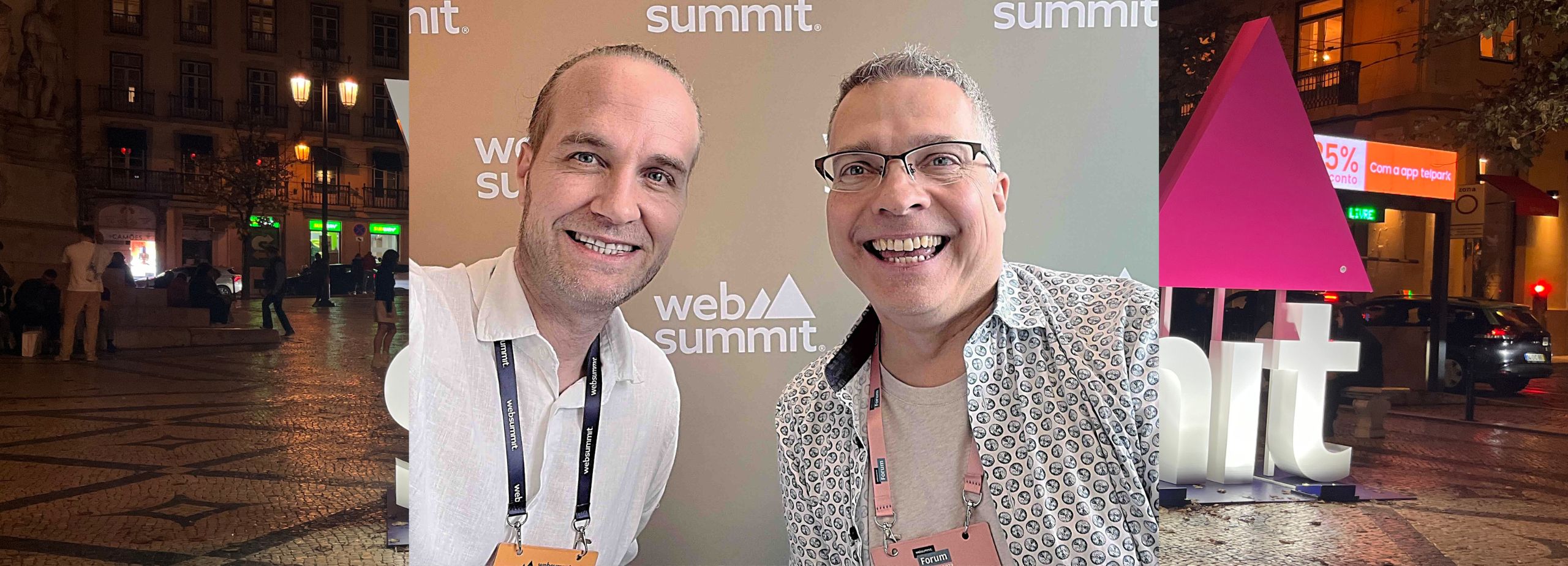
Full transparency before we go further. Metricool is one of the sponsors of my podcast, Web3 CMO Stories. And before this playbook was published, the Metricool team reached out to ask if they could feature me in it as one of their brand ambassadors. I said yes. I am mentioning this up front not only because disclosure matters, but because the way that mention came about is itself the subject of this article. It was not the result of a campaign or a paid placement. It grew out of years of conversations and trust. Which is, quite literally, what the report is about
LinkedIn Playbook by Metricool x Favikon
This is not a LinkedIn story. It is an AI story.
At first glance this looks like a report about one social platform. It is not. It is the first large dataset I have seen that measures a shift I have been arguing for since my TEDx talk and my book The Future CMO: in the AI era, trust becomes the scarcest asset in marketing.
Here is the argument in one paragraph. For decades, marketing had a distribution problem. Creating content was expensive and publishing consistently was hard, so whoever could publish the most tended to win. AI removed that bottleneck. Every company can now produce articles, posts, videos and newsletters at scale. So the scarcity moved. When everyone can publish, being believed becomes the advantage. And belief does not travel through company pages. It travels through trusted people.
When I gave my TEDx talk, that was a prediction. Reading this report, I realised we are no longer predicting the shift. We are starting to measure it.
Three findings from the playbook stand out, and together they tell one story.
People outperform pages, and not because of reach. Company pages and personal profiles earn roughly the same impressions per post. Yet personal profiles generate 63% more engagement. The gap is not visibility. It is behaviour. People respond differently when a person speaks. Ask yourself when you last commented on a corporate announcement, and then ask when you last replied to a founder or an employee sharing a real experience. Company pages distribute. People create trust.
Engagement went underground. Likes, comments and shares all dropped compared to last year. On the surface, LinkedIn looks quieter. But clicks, the interactions nobody else can see, went up, and total engagement rose by almost 14%. I explored this in an earlier podcast episode, What Happens When The Like Button Dies?, and this report delivers the data behind it. Engagement did not disappear. It moved out of sight. Your buyers are reading, clicking and deciding silently. If you judge your LinkedIn presence by visible applause alone, you are measuring the wrong thing.
Size was never the signal. A company page with fewer than 2.000 followers averages roughly the same engagement rate as a page with over a million. The algorithm does not punish you for being small. For founders, consultants and B2B teams without a big brand behind them, that is not a threat. It is an invitation.
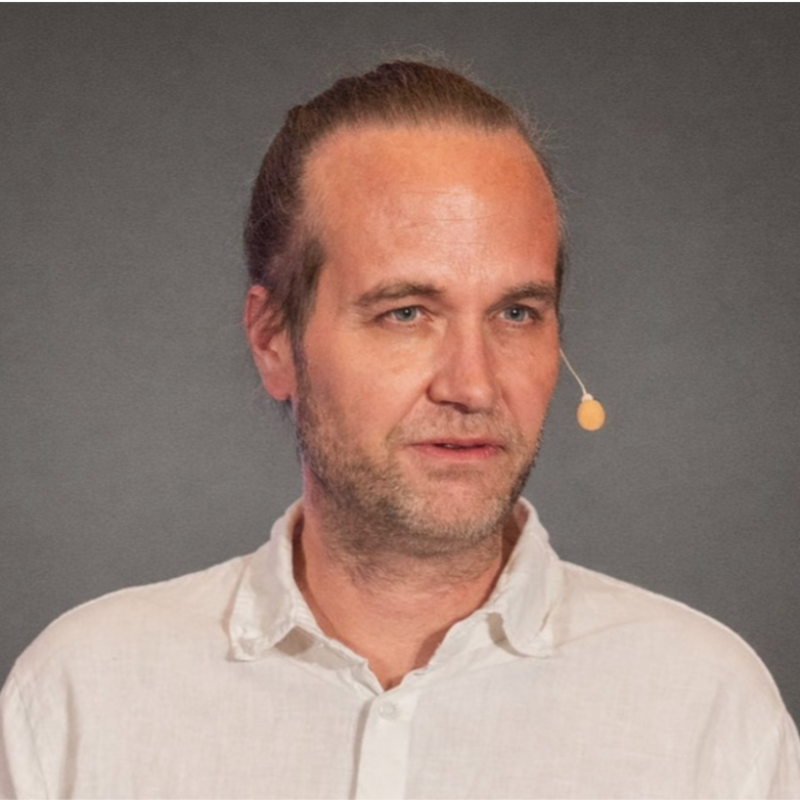
Joeri Billast on LinkedIn
The three circles: build inward first
The most useful framework in the report is what Metricool and Favikon call the three circles of LinkedIn growth: employees, customers and partners, and external creators.
The counterintuitive advice is to build inward first. Most brands skip straight to influencer partnerships while their most underused channel is already on payroll. Your employees' combined networks usually exceed your company page's reach, and their posts carry far more trust than brand-authored content. The report is equally clear about the risk of skipping ahead: a creator partnership built on top of an empty trust layer does not land.
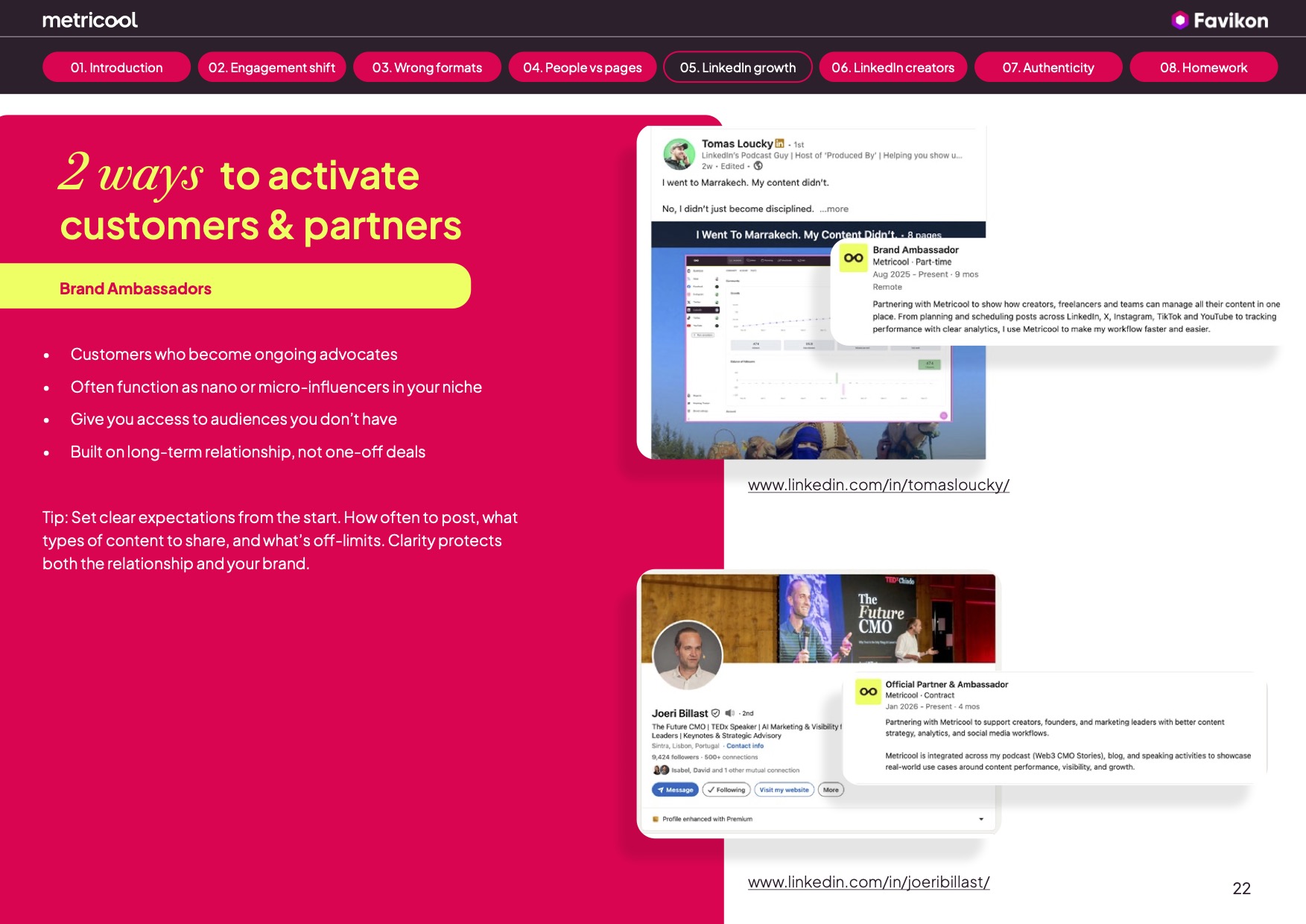
The second circle is where I ended up personally. The report describes brand ambassadors as customers who become ongoing advocates, built on long-term relationships rather than one-off deals. That is an accurate description of how my own collaboration with Metricool developed, and it is why I find the framework credible. A brand is not only what it says about itself. It is what trusted people around the brand are willing to say.
One practical note for anyone activating employees or ambassadors: do not script them. Scripted posts sound hollow. Give people topics and freedom, plus one habit that the data strongly supports: end every post with a question. According to the report, posts that include a question receive 77% more comments. One sentence, measurable difference.
Authenticity becomes a performance metric
The Favikon side of the report adds the dimension I find most significant for where marketing is heading. Follower count tells you how many people showed up. It tells you nothing about whether they listen.
Favikon evaluates creators across five dimensions: post content quality, engagement quality, follower credibility, expertise signals and content originality, including how much of a creator's output appears to be AI-generated. In their sample analysis, the creator with the largest audience scored lowest on authenticity, while a creator with a fraction of the followers scored highest. Ranked by followers, you would have picked the wrong partner. Ranked by authenticity, the decision inverts.
Authenticity used to be a value. It is becoming a metric. And in a feed where AI can produce unlimited plausible content, the question for every partnership, every ambassador and every hire becomes the same: does the audience actually listen?
What CMOs and founders should do now
If I compress this into actions for the next quarter, it looks like this. Stop measuring LinkedIn success by visible metrics alone, because the decisive engagement is increasingly silent. Shift weight from your company page to the people around your brand, starting with employees, then customers and partners, and only then external creators. Replace volume targets with design targets, because more content is not the strategy, better designed content is. And when you evaluate creators or ambassadors, vet them on authenticity rather than audience size.
Above all, ask the mirror question I closed the podcast episode with. If your company page went silent tomorrow, who would still be talking about your brand? If the answer is almost nobody, that is not a content problem. That is the work.
It is exactly the work we do atSintra Synergies, where founders and marketing leaders spend focused time on becoming visible, trusted and chosen in the AI era.
Do LinkedIn company pages still matter in 2026? Yes, but their role has changed. Company pages remain effective for distribution: posts with links on company pages perform well on impressions, and pages organise information and reinforce credibility. What they rarely do is start conversations. The Metricool x Favikon data shows personal profiles generate 63% more engagement at similar reach, so the strongest strategy uses personal profiles to start conversations and the company page to spread them.
What is a brand ambassador on LinkedIn? According to the Metricool x Favikon playbook, brand ambassadors are customers who become ongoing advocates for a brand. They often function as nano or micro-influencers in their niche, give brands access to audiences they do not own and are built on long-term relationships rather than one-off deals.
Why do personal profiles outperform company pages on LinkedIn? Not because of reach. Impressions per post are roughly similar. The difference is what people do when they see the content: audiences reply to people far more than to logos. On average, personal profiles receive substantially more comments per post than company pages.
What is an authenticity score? Favikon's authenticity model evaluates creator profiles across five dimensions: post content quality, engagement quality, follower credibility, expertise signals and content originality. It is designed to answer a question follower counts cannot: whether a creator's audience genuinely listens.
Fractional CMO and AI Visibility Strategist. Author of The Future CMO, endorsed by Philip Kotler. Host of the Web3 CMO Stories podcast and founder of the Sintra Synergies retreat.
About the author
Joeri Billast
Joeri Billast is a Fractional CMO and AI Visibility Strategist based in Sintra, near Lisbon. He is the author of The Future CMO, endorsed by Philip Kotler, and hosts Web3 CMO Stories. The Library is where he publishes his articles, interviews and briefings.