
We pull six leadership lessons from Michael Jordan, Jason Robins and Carsten Koerl at SBC Summit in Lisbon and translate them into practical guidance for marketers, founders, and business leaders. We argue that AI makes visibility cheap, while authenticity, focus, and judgment become the scarce advantages.
• Authenticity before visibility, choosing partnerships that make immediate human sense
• Credibility as the scarce asset when AI scales content and distribution
• Focusing on what we can control, cutting through data noise and dashboard overload
• Keeping personal brands aligned with the team goal so they strengthen the company
• Building option value instead of betting on a single predicted future, with AI as the clearest example
• Treating AI as an innovation engine in product development, not only an efficiency tool
• Remembering that data informs decisions but never removes uncertainty or the need for judgment
Key Business Lessons from Michael Jordan, DraftKings and Sportradar at SBC Summit 2026
What can business leaders learn from Michael Jordan about authenticity, focus, personal branding and decision-making in an AI-driven world? At SBC Summit 2026 in Lisbon, Jordan joined DraftKings co-founder and CEO Jason Robins and Sportradar founder and CEO Carsten Koerl for a conversation about leadership, technology, data, AI and the future of sports business. These are my key takeaways from the session.
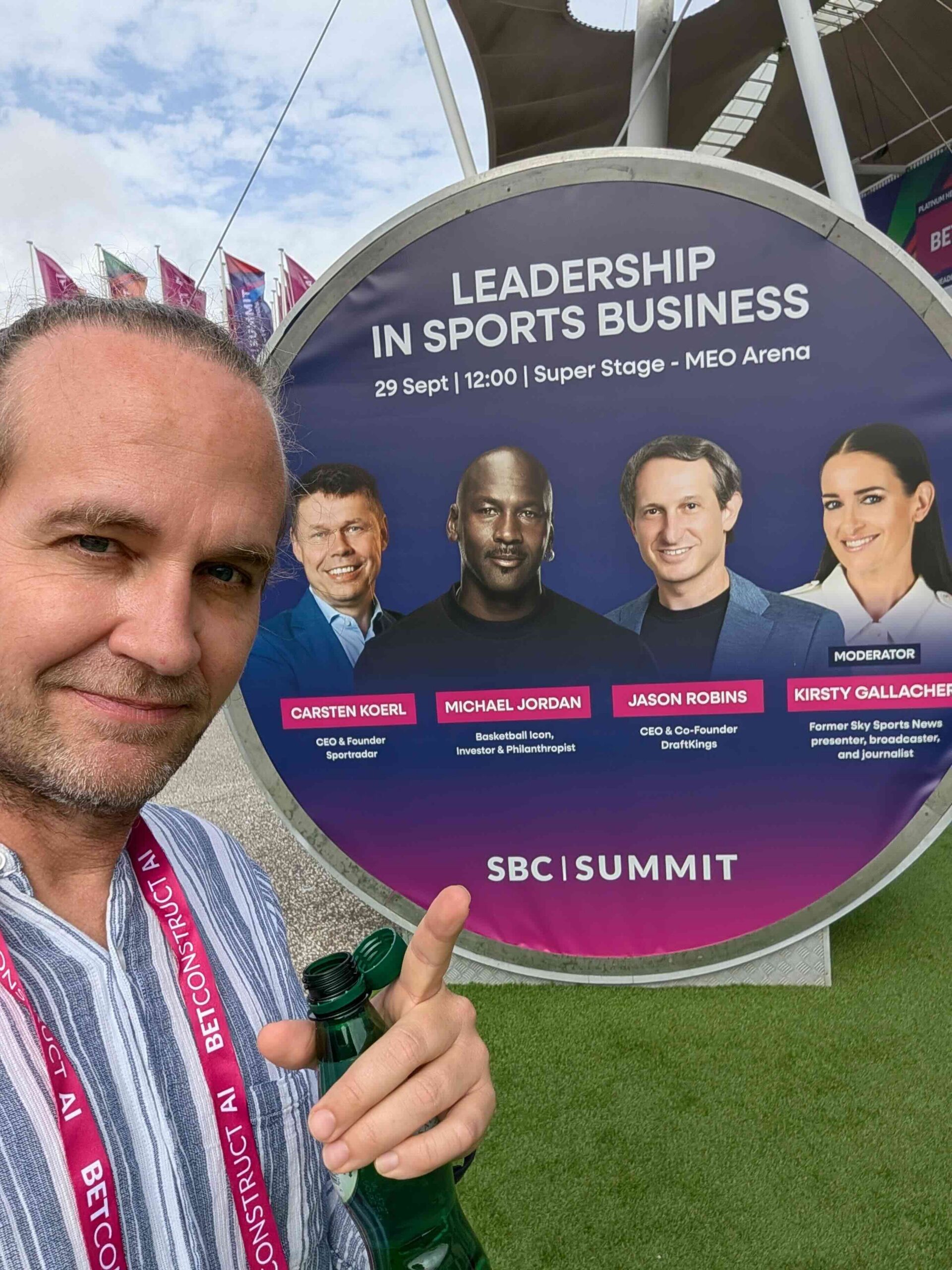
On Tuesday, September 29, I was sitting in the MEO Arena in Lisbon when hundreds of phones suddenly went into the air. Then Michael Jordan walked onto the stage.
Jordan opened SBC Summit 2026 alongside Jason Robins, co-founder and CEO of DraftKings, and Carsten Koerl, founder and CEO of Sportradar.
The official topic was Leadership in Sports Business. But some of the most interesting lessons had very little to do with sports. The conversation touched on authenticity, focus, personal brands, AI, prediction markets, real-time data, fan engagement and what happens when companies need to make decisions without knowing exactly what the future will look like. Rather than simply summarizing the panel, I want to share the ideas that stood out to me and what I think they mean for marketers, founders and business leaders.
1. Michael Jordan on authenticity: the connection has to make sense
One of Michael Jordan's comments was especially relevant to me. When he gets involved with a company, investment or business opportunity, there needs to be an authentic connection to who he is. The consumer needs to understand why that connection exists. If there is a disconnect, people notice it.
Jordan used NASCAR as an example. His involvement in motor racing was not something manufactured in a marketing meeting. He grew up around racing in North Carolina and already had a connection to the sport. He then saw an opportunity to help NASCAR reach beyond its traditional audience. That distinction matters.
Marketers often start with a question such as: How can we make this partnership work? A better question might be: Why should this partnership exist in the first place?
Related Posts:






If you need a complicated story to explain why two people or brands belong together, your audience will probably feel the disconnect too. Why authenticity matters even more in the age of AI. This becomes particularly relevant as AI transforms marketing.
Visibility has never been easier to manufacture. AI can create content. Platforms can distribute it. Influencers and partnerships can extend the reach. Paid media can put it in front of millions of people. But none of those things can make a relationship feel credible when the underlying connection is not there. Visibility can be scaled. Credibility still has to be earned. And as content becomes increasingly abundant, genuine credibility may become more valuable rather than less.
2. Focus on what you can actually control
Jordan was also asked how he would approach professional basketball if he were playing today. Modern athletes operate in an environment filled with statistics, social media, fantasy sports, betting markets, sponsorships, personal brands and constant public scrutiny.
Jordan's answer was surprisingly simple. When he played, his objective was to win the game. He was not thinking about who was betting on him or whether somebody expected him to score a particular number of points. He focused on his opponent, his own performance and what he could influence on the basketball court.
There is a strong business lesson here. More data does not always mean more clarity. Marketers today have access to more information than any previous generation.
We have:
- analytics dashboards
- attribution models
- social metrics
- customer data
- AI-generated insights
- predictive analytics
- competitive intelligence
- real-time signals
That sounds like progress. But more information can also create more noise. The important question becomes: Which part of this can I actually influence?
You cannot control the LinkedIn algorithm. You cannot control when a prospect decides to buy. You cannot control what a competitor launches next month.
But you can influence:
- the quality of your thinking
- the clarity of your positioning
- the customer experience
- the quality of your content
- the conversations you initiate
- the consistency of your execution
Jordan's environment may have become far more complex since his playing days. His underlying principle remains simple: Know the game you are actually playing and focus on the part you can influence.
3. What happens when the personal brand starts competing with the team?
Jordan also made an interesting observation about modern athletes. Today's players are not only part of a team.
They often have:
- their own social media audiences
- personal sponsorships
- individual logos
- merchandise
- commercial partnerships
- media businesses
- investment portfolios
Jordan suggested that this can sometimes take attention away from the team objective. That tension extends far beyond professional sport. Personal brands can strengthen companies, but they can also compete with them. I strongly believe executives, founders and experts should build visibility.
In an AI-driven world, trusted individuals may actually become more important to organizations. People follow people. Executives can create credibility and distribution that corporate accounts struggle to achieve.
But there is an important distinction between: a personal brand that strengthens the business and a personal brand that starts competing with the business.
If a CEO, CMO or founder becomes a strong public voice, that can create enormous value. But the individual's reputation and the company's strategy should reinforce one another.
Jordan himself is arguably one of the strongest personal brands in sports history. Yet when he talked about basketball, his perspective remained fundamentally team-first. That tension is increasingly relevant as more business leaders become creators.
4. Jason Robins: don't predict one future, build options
One of the strongest strategic observations of the session came from Jason Robins. The DraftKings co-founder was discussing emerging markets and technologies, including prediction markets. His point was that nobody really knows exactly how these markets will evolve.
There are:
- regulatory uncertainties
- legal uncertainties
- changes in consumer behavior
- technological shifts
- competitive risks
Instead of pretending the company can perfectly predict the future, DraftKings tries to position itself so that it can succeed under several possible outcomes. Robins described this in terms of option value.
He referenced NFTs as an earlier example. During the NFT boom, nobody knew whether NFTs would become a permanent category or whether enthusiasm would eventually collapse.
DraftKings entered the market. They participated. They learned. They created exposure to the opportunity. But the entire future of the company did not depend on NFTs becoming the dominant model.
Robins described prediction markets in a similar way. The final outcome depends partly on legal and regulatory developments that DraftKings does not control. So the goal is not necessarily to predict the future perfectly. It is to remain well positioned under multiple possible futures.
5. What this means for AI strategy
The same principle applies directly to AI. Consider the questions companies are asking today: Will ChatGPT dominate? Will Gemini? Will Claude? Will autonomous AI agents become the primary interface? Will customers stop visiting websites and interact mainly through AI assistants? Will search engines remain dominant?
Nobody knows with certainty. Building your entire company around one prediction is therefore risky. A stronger strategy may be: How do we build capabilities that remain valuable under several possible futures?
That can mean:
- owning first-party knowledge
- strengthening direct customer relationships
- creating structured and machine-readable content
- building systems that can work with multiple AI models
- developing internal AI capabilities rather than relying on one vendor
- learning faster than competitors
- creating proprietary data and expertise
In uncertain markets, adaptability can become a stronger competitive advantage than prediction. Robins also made another important point. When the environment is easy, many companies can perform well. Difficult environments expose the differences. When the outcome is uncertain and you still need to make decisions, strategy becomes visible.
6. Carsten Koerl: AI innovation is not the same as AI efficiency
Carsten Koerl brought the discussion directly into artificial intelligence. The Sportradar founder described how AI is already being used in product development.
One example involved multiple AI agents operating in parallel. Different agents can work on different elements of a product:
- compliance
- mathematical models
- security
- testing
- product development
Processes that previously required hundreds of development hours can potentially happen much faster. Products can also become more personalized and responsive. But Koerl then made a distinction I found particularly important.
Using AI for cost reduction and efficiency may be useful and even necessary. But that is not where he sees the real innovation. The innovation happens in the product.
7. The better AI question: what becomes possible?
A large percentage of corporate AI conversations still focus on productivity:
How can we write emails faster?
How can we generate marketing content faster?
How can we automate customer support?
How can we reduce costs?
How can we complete existing processes with fewer people?
Those improvements can create value.
But competitors can often implement similar efficiencies.
The more strategic question is:
What can we create now that was previously too expensive, too slow or technically impossible?
For example: Can we create entirely new customer experiences? Can every customer receive a genuinely personalized product? Can services adapt in real time? Can multiple AI agents collaborate on tasks that previously required entire teams? Can AI create new business models rather than simply optimize existing ones?
That is where AI moves from being a productivity tool to becoming an innovation engine. For CMOs and business leaders, that distinction matters. Don't only ask: What can AI make cheaper? Also ask: What can AI make possible?
8. Real-time data is changing sports business
A major theme throughout the SBC Summit session was the increasing importance of data. Sportradar sits at the intersection of sports, technology, media and betting. Koerl explained how increasingly sophisticated systems capture detailed information about players and games. AI models can then analyze enormous quantities of data and predict likely outcomes.
Sports betting is becoming increasingly real-time. Fan experiences are becoming more personalized. Media experiences are becoming richer. Sports, gaming, media, technology and data are converging. But there is an interesting paradox.
9. More data does not remove uncertainty
The sports industry can gather extraordinary quantities of information. Models can calculate probabilities. AI can recognize patterns humans might miss. Platforms can respond in real time. But sport remains unpredictable. And that unpredictability is one of the reasons people watch.
At some point, somebody still has to take the shot. An athlete still has to respond to what the opponent does. A decision has to be made in the moment. You can have enormous amounts of data without having certainty.
The same principle applies in business. Data can help us make better decisions. AI can improve our understanding. Predictive models can show us probabilities. But none of them eliminate judgment. And none of them eliminate uncertainty.
The strongest leaders may not necessarily be the people with the most information. They may be the people who can combine information with judgment and still act when certainty is impossible.
10. The paradox at the heart of the conversation
What fascinated me most about the panel was the contrast between the technology being discussed and the principles Michael Jordan repeatedly brought back into the conversation.
The sports industry is becoming increasingly sophisticated.
We now have:
- artificial intelligence
- real-time data
- advanced analytics
- prediction markets
- personalization
- betting technology
- new media models
- powerful personal brands
Everything is becoming more measurable, connected and automated. Yet Jordan's perspective kept returning to remarkably human ideas:
Be authentic.
Know what you can control.
Stay focused.
Compete.
Don't lose sight of the team.
Perhaps that is the bigger lesson. Technology changes the environment. It does not necessarily change the fundamentals of performance. AI can increase our capabilities. Data can improve our decisions. Platforms can scale our visibility. But none of those things replace authenticity, judgment, discipline or focus. And perhaps those qualities become more valuable as technology becomes more powerful.
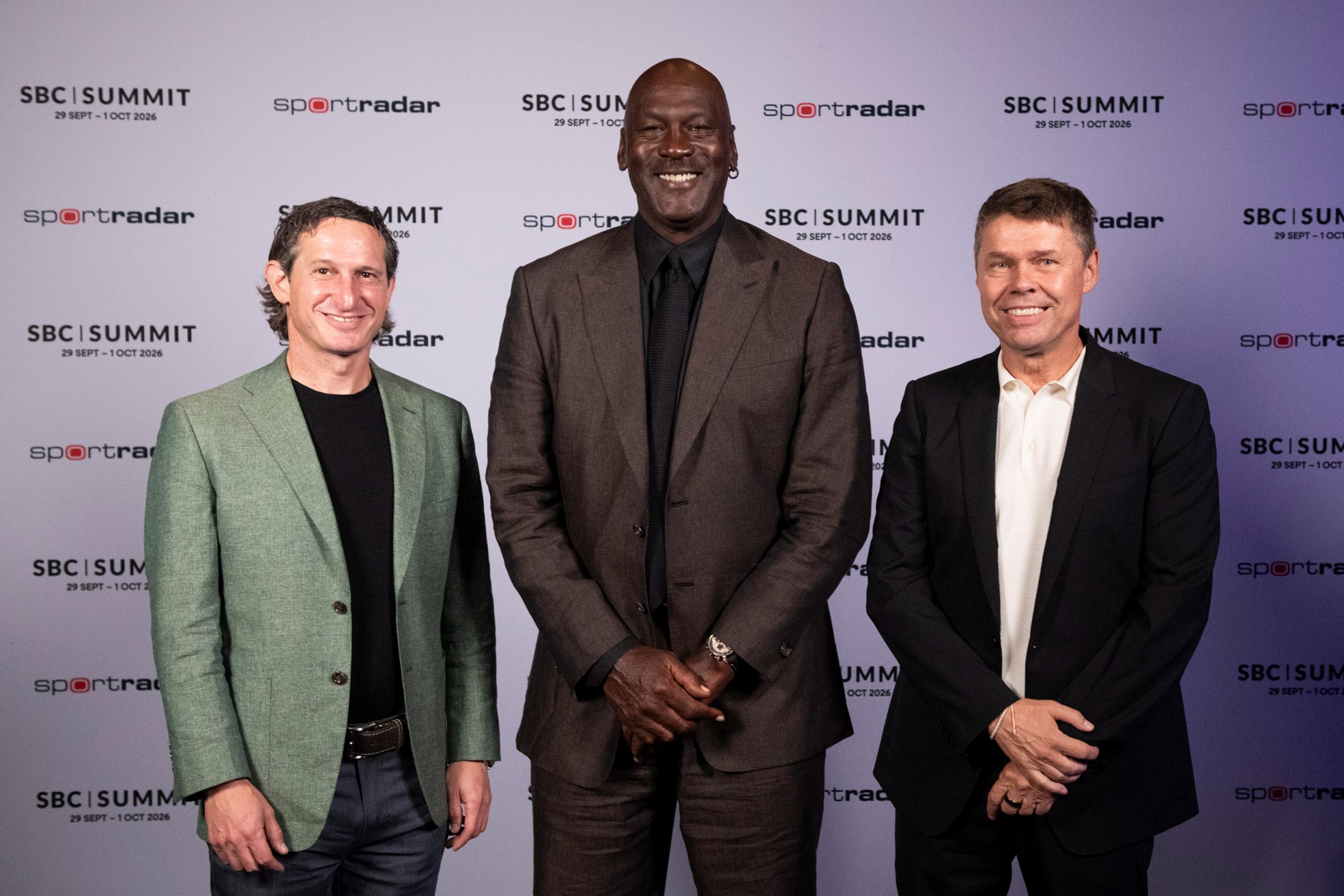
Michael Jordan, Jason Robins and Carsten Koerl backstage before the “Leadership in Sports Business” session at SBC Summit 2026 in Lisbon. Photo credit: Sportradar.
Key takeaways from Michael Jordan, Jason Robins and Carsten Koerl at SBC Summit
If I had to reduce the conversation to six business lessons, they would be:
- Authenticity must come before amplification.
A partnership becomes stronger when the audience immediately understands why it exists. - Focus on what you can influence.
More data and more metrics do not necessarily produce better decisions. - Personal brands should reinforce the organization.
Executive visibility creates value when individual and company objectives remain aligned. - Don't rely on predicting one future.
Build capabilities that create value across multiple possible outcomes. - Use AI to innovate, not only to become more efficient.
Cost savings matter, but new products and experiences create greater strategic differentiation. - Data improves probability, not certainty.
Human judgment remains essential even in highly data-driven environments.
About the SBC Summit 2026 session
The Leadership in Sports Business session took place on September 29, 2026, during SBC Summit in Lisbon, Portugal.
The panel featured:
Michael Jordan
NBA legend, entrepreneur, investor and sports business leader. Jordan has built one of the world's most recognizable athlete brands and has investments across several areas of sports and business, including basketball and NASCAR.
Jason Robins
Co-founder, CEO and Chairman of DraftKings, the digital sports entertainment and gaming company operating across sports betting, daily fantasy sports and online gaming.
Carsten Koerl
Founder and CEO of Sportradar, a global sports technology company providing data, technology and services across sports media, betting, gaming and sports organizations.
The conversation explored the evolution of sports business, fan engagement, betting, artificial intelligence, data, prediction markets, personal branding and emerging technology.
Listen to the episode
In this episode of Web3 CMO Stories, I share my analysis and key takeaways from the opening session of SBC Summit 2026 featuring Michael Jordan, Jason Robins and Carsten Koerl.
Rather than replaying the panel, I focus on what the conversation means for marketers, founders, CMOs and business leaders navigating AI, technology and changing customer behavior.
Listen to the full episode of Web3 CMO Stories:
https://www.cmo-stories.com/1903080/episodes/19887059-michael-jordan-at-sbc-summit-authenticity-focus-and-the-future-of-business-s6-e42
Frequently asked questions
What did Michael Jordan say about authenticity at SBC Summit?
Michael Jordan explained that the business opportunities and partnerships he becomes involved with need to connect authentically to who he is. The consumer should be able to understand that connection. If the relationship feels disconnected from the person behind it, credibility suffers.
What business lesson can marketers learn from Michael Jordan?
One of the clearest lessons is to focus on what you can influence. Jordan described how, as an athlete, his attention stayed on his opponent, his performance and winning rather than external statistics, betting markets or other noise.
For marketers, the equivalent is focusing on positioning, customer experience, quality and execution rather than becoming distracted by every metric or algorithm change.
What did Jason Robins say about prediction markets?
Jason Robins explained that companies cannot always predict which emerging markets or technologies will succeed. Instead, businesses can position themselves to perform well under multiple potential outcomes. He described this as maximizing option value.
What did Carsten Koerl say about AI?
Carsten Koerl argued that while AI can create efficiencies and reduce costs, the most interesting innovation happens when AI is used to create new products and customer experiences.
What is the main business lesson from the SBC Summit panel?
Technology, AI and data are making sports and business increasingly sophisticated, but fundamental human qualities such as authenticity, focus, judgment and discipline remain essential.
Want to see more of my articles in Google? Add webdrie.net as a preferred source.